Understanding your potential Ripple savings rates is key when considering joining one of our cooperative renewable energy projects. While it would be easy to showcase best case scenario rates only, we seek to offer full transparency and to remind all our existing and prospective members that long-term thinking and bill stabilisation is the goal, not short-term savings spikes.
In this article we are going to look at member savings in more detail. We will discuss how rates are set, what affects the final price and include real examples from our Graig Fatha wind farm, so let’s dive in.
How Ripple savings rates are determined
Ripple savings rates are calculated using the following equation:
Savings rate = total electricity value - operating costs
Total electricity value = wholesale energy value + embedded benefits + green certificate value
It is important to note that savings are calculated against the wholesale value of the electricity, not the retail value. This means members still pay grid charges, taxes and levies and all the other costs that make up your final bill..
Ripple fixes the electricity value annually, a couple of months before the end of the previous contract. We then deduct the operating cost, leaving the savings rate for that year.
On any given day, the value of the electricity for the following year is largely dictated by the market. We monitor market prices to assess when prices offered deliver best value given the market conditions.
Instead of the supplier paying the wind farm or solar the agreed electricity price, it pays the operating cost to the project and the rest to its owners as a saving on their bill.
What can impact Ripple savings rates?
As a general–but not concrete–rule, savings are higher when the wholesale market electricity price is higher. Your bills (ignoring any Ripple saving) are also likely to be higher as the wholesale price affects your electricity costs. The reverse is also usually true, that lower wholesale electricity prices will result in a lower savings rate. But your bill is also likely to be lower. The net effect is to help stabilise your electricity bills over the long term. It does not offer perfect protection, but some.
The value of the green certificates issued to the project, as well as any embedded benefits (grid benefits) also have an impact on the total value of electricity, and hence your savings.
Savings rates require long-term mindsets
We mustn’t lose sight of shared long-term goals. If one year has been exceptionally lucrative in terms of bill savings, this could naturally dull the lustre of what would have been above-expected rates in years to come. Please see below for an example from Graig Fatha.
It can be tempting to hope for very high electricity prices, as these are usually great for Ripple members, but they had a devastating impact on millions. In 2023, this exact scenario played out and crippled many vulnerable households financially and leading to the “heat or eat” crisis.
Savings case study: Graig Fatha 2023 vs 2024
The Graig Fatha year 3 generation savings rate has now been fixed. From 1st March 2024 the new savings rate will be 6.55p/kWh. The average Graig Fatha member’s annual savings are likely to be around £215, though this is an average figure. The more shares of the wind farm owned; the more members will save.
This new rate is in stark contrast to last year’s figure of 27p/kWh. The purple dots on the graph below show when the Graig Fatha prices were fixed. As you can see market prices have plummeted since the price was previously fixed in late 2022.
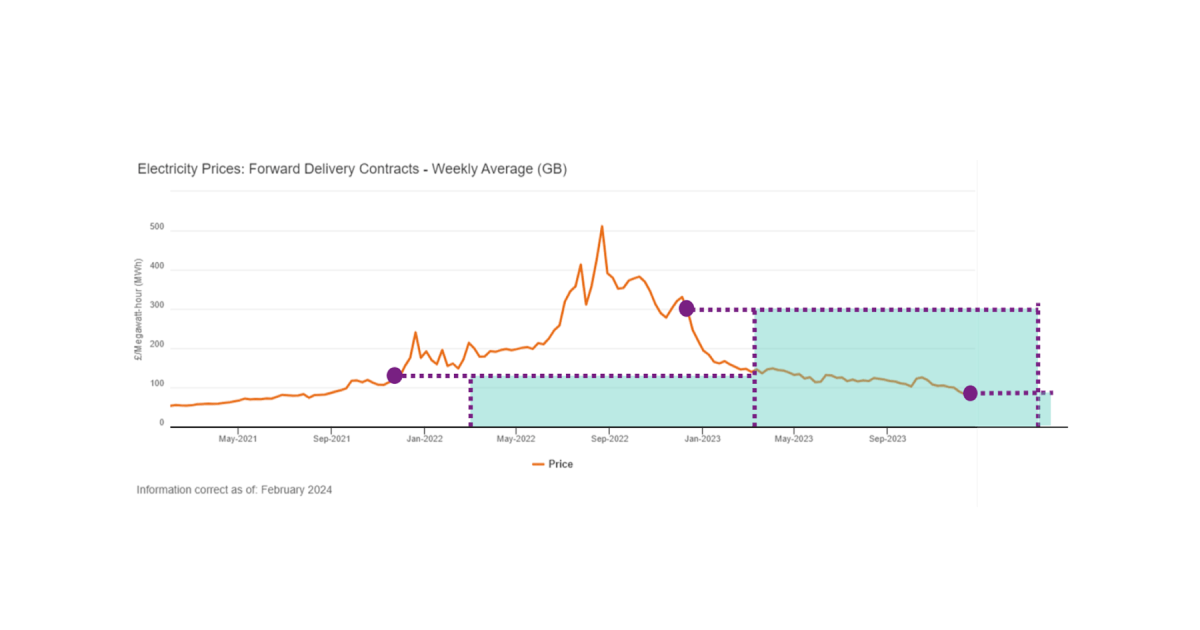
(note £100/MWh = 10p/kWh)
Energy prices are still forecasted to remain higher than in previous years, but they have been steadily reducing since the peak in late 2022. This is a good thing overall. Last year’s savings were so high due high market prices when we fixed the price. It was a bumper year for Graig Fatha members, but a tough time for most other energy consumers. Such unusual years should not be used as a benchmark for future rates.
We hope this has clarified how savings rates are fixed and why they can change drastically from year to year. If you’d like any further information or support, please get in touch with our member support team, who will be happy to help.