We asked Simon, a Ripple member to talk about how owning a wind farm with hundreds of other people has made his beloved EV cheaper (and greener) to run.
My name is Simon M. I’m a Ripple community member and wanted to write this blog to talk about my passion for electric cars (EVs), alongside my personal mission to stop burning fossil fuels. I live in a leafy Surrey suburb with my wife Barbara and my youngest son.
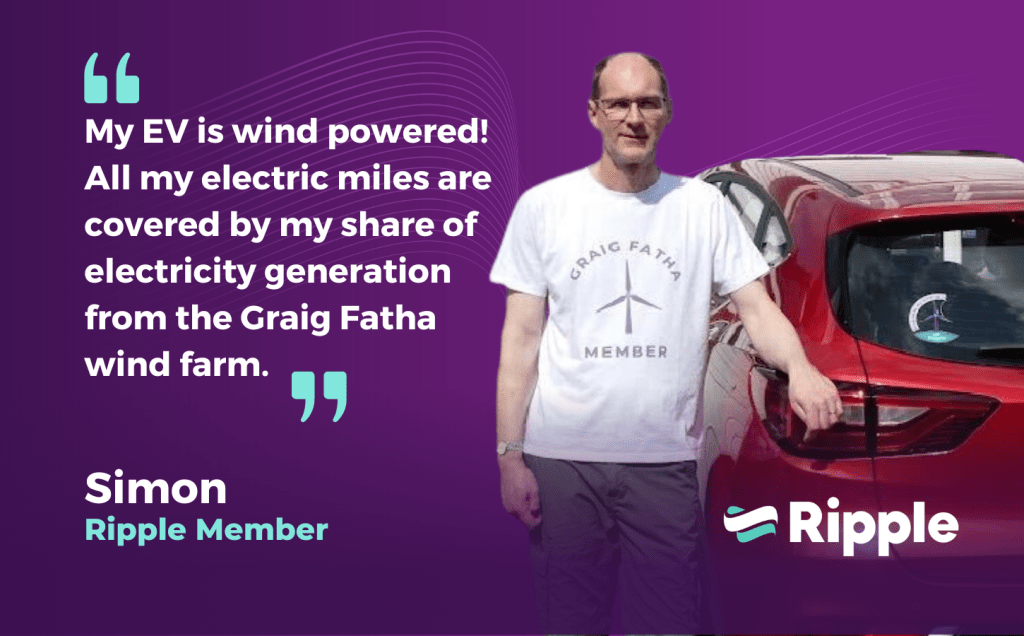
I’m an active member of EVA England, an organisation that gives EV owners such as myself–as well as prospective drivers–a voice to help and promote the switch to clean transport. I have volunteered at several live events, helping others to understand more about the cars, while busting some myths and concerns that many people have about EV ownership, including how to make it cheaper.
A wind-powered cheaper EV
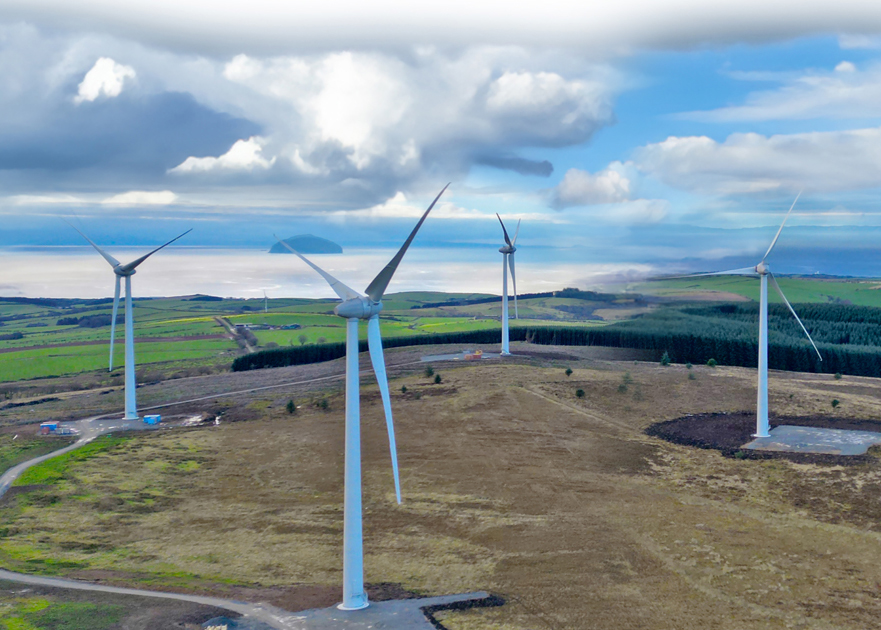
My electric car runs on wind power… literally! Every electric mile I drive is fueled by my share of the clean energy generated by the Graig Fatha wind farm!
Being part of a co-op via Ripple Energy allows me direct ownership of a wind turbine. I receive 5000 kWh of clean energy produced by our turbine every year, rather than relying on someone else to buy renewable wind power on the wholesale market. The electricity is sold to my energy provider (Octopus) and my home charger fills up the battery of my car, which uses about 1100 kWh per year. It’s a great feeling to know that no fossil fuels were burnt in the making of my car’s electricity and that my (cheaper to run) EV does not spew nasty pollution while I drive.
Making a green decision
So, which came first; the idea of generating my own clean electricity or wanting to swap my old car for a shiny new electric one? Well, wanting to upgrade my car probably predated my discovering Ripple Energy. However, I met the team at the 2019 Fully Charged Show, where they were promoting wind power.
Later that year I bought an MG ZS EV, having pre-ordered it after enjoying a test drive at a local garage. My EV is easy to drive, being an automatic. It’s very responsive and quieter than any other car I’ve owned. My wife and I share the car for all our local errands and occasional longer trips.
Running costs are low due to cheap electricity provided by using overnight charging, as part of a ‘smart time of use’ tariff. For us, it works out to be 2p per mile versus about 17p per mile for an average petrol car. Maintenance costs are cheaper as well because there are fewer moving parts and so far, reliability has been very good.
Long EV journeys? No problem!
Do we worry about range on a longer journey? Well, my car has a maximum range of around 160 miles at non-motorway speeds but it’s usually my bladder range that is the limiting factor. I need to stop long before the car does and a quick 30-minute charge is normally plenty to complete most of our journeys.
I’ve found that knowing where to power up and which charging networks are best is the key to successful public charging. I would recommend using ZAP Map, or similar apps, to plan where to stop and charge. I find destination chargers (low powered A/C) also helpful when you park for several hours at a hotel or shopping centre.
Many more affordable second-hand EVs are entering the market now, offering greater choice of sizes, ranges, and styles. If you want to know more, I’d recommend attending a local EV event where you can meet existing owners. Most of us are more than happy to chat and answer questions and you’ll get an objective opinion from those that have already made the switch.
Now you’ve read my story, could it be the right time for you to move to an electric car and green energy and help clean the air?