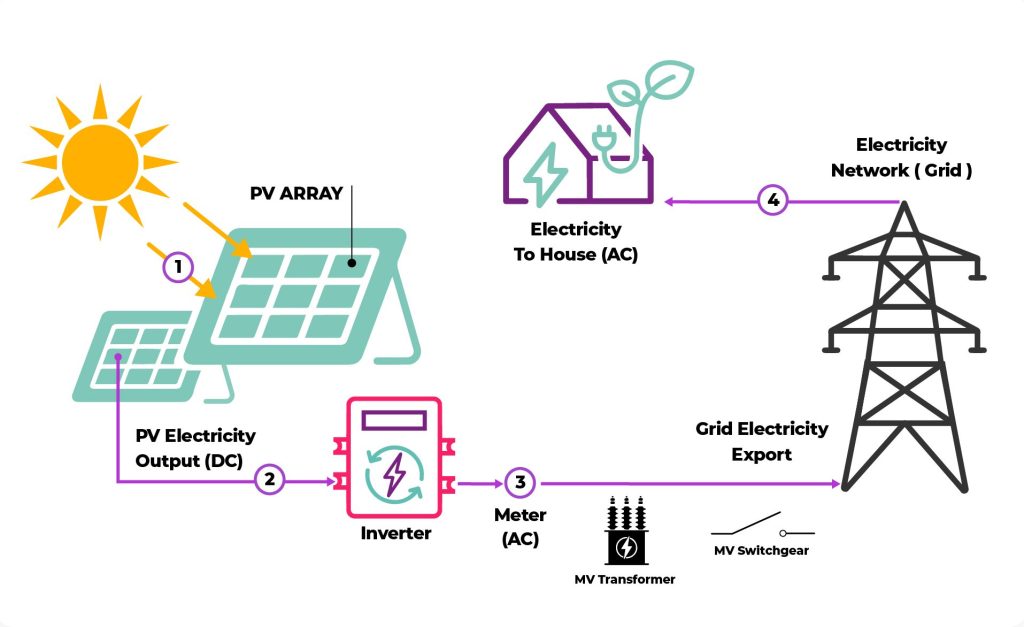
Derril Water Solar Park will be the UK’s first shared solar park and we want to show you how the site will actually work, so you’re not in the dark. What will it be made of, how do the different parts work together, and how do they generate green electricity? Read on to find out all this and more.
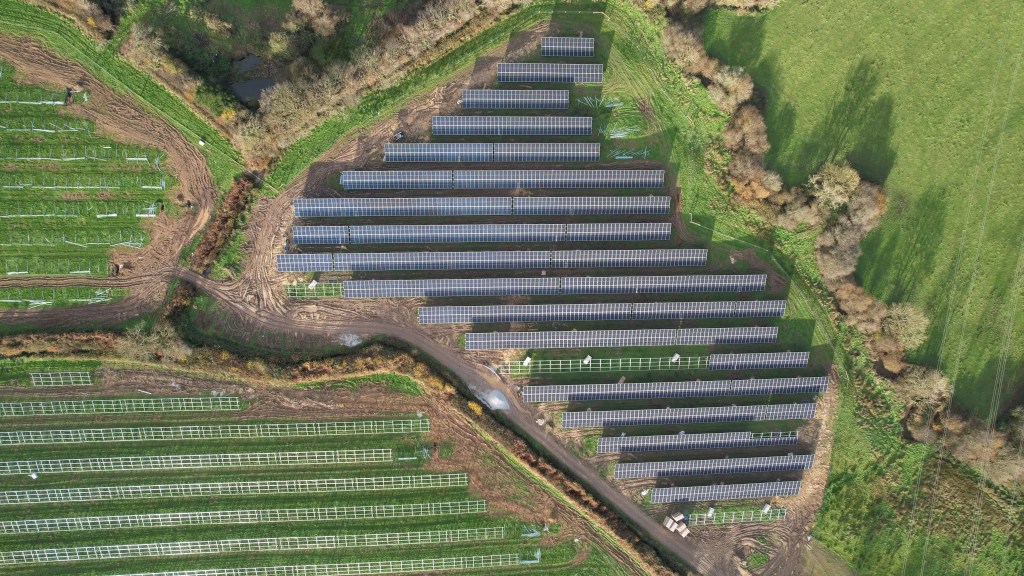
Solar panels
Solar panels are made up of smaller units called solar cells. A typical 4 × 4-inch solar cell generates around 2 watts of electricity (less than an average light bulb uses), so cells are usually combined in series to boost the voltage or in parallel to increase the current. A solar–or photovoltaic–module generally consists of interconnected cells laminated to glass, all within an aluminium frame. In turn, one or more of these modules may be wired and framed together to form a solar panel.
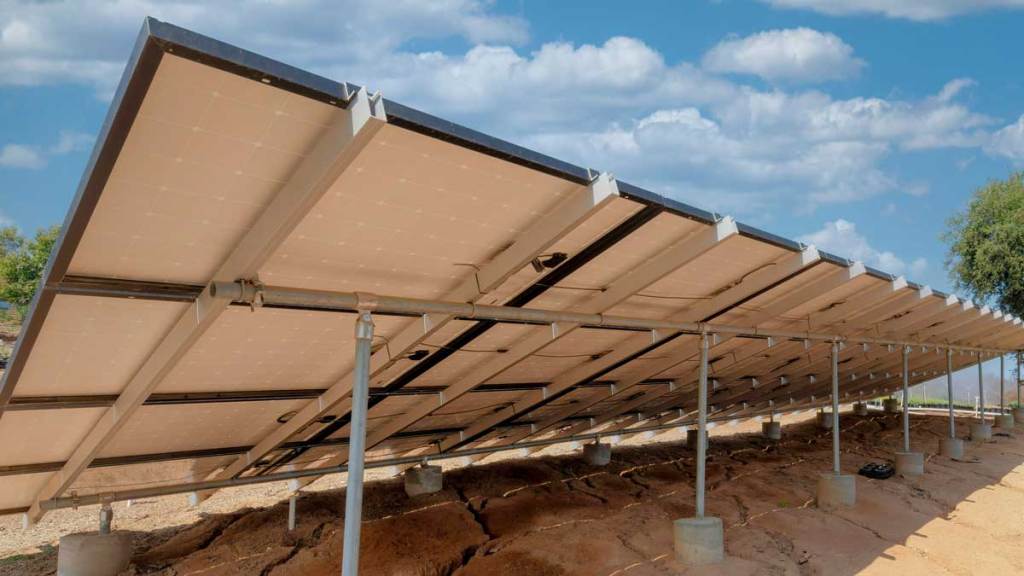
Steel frames
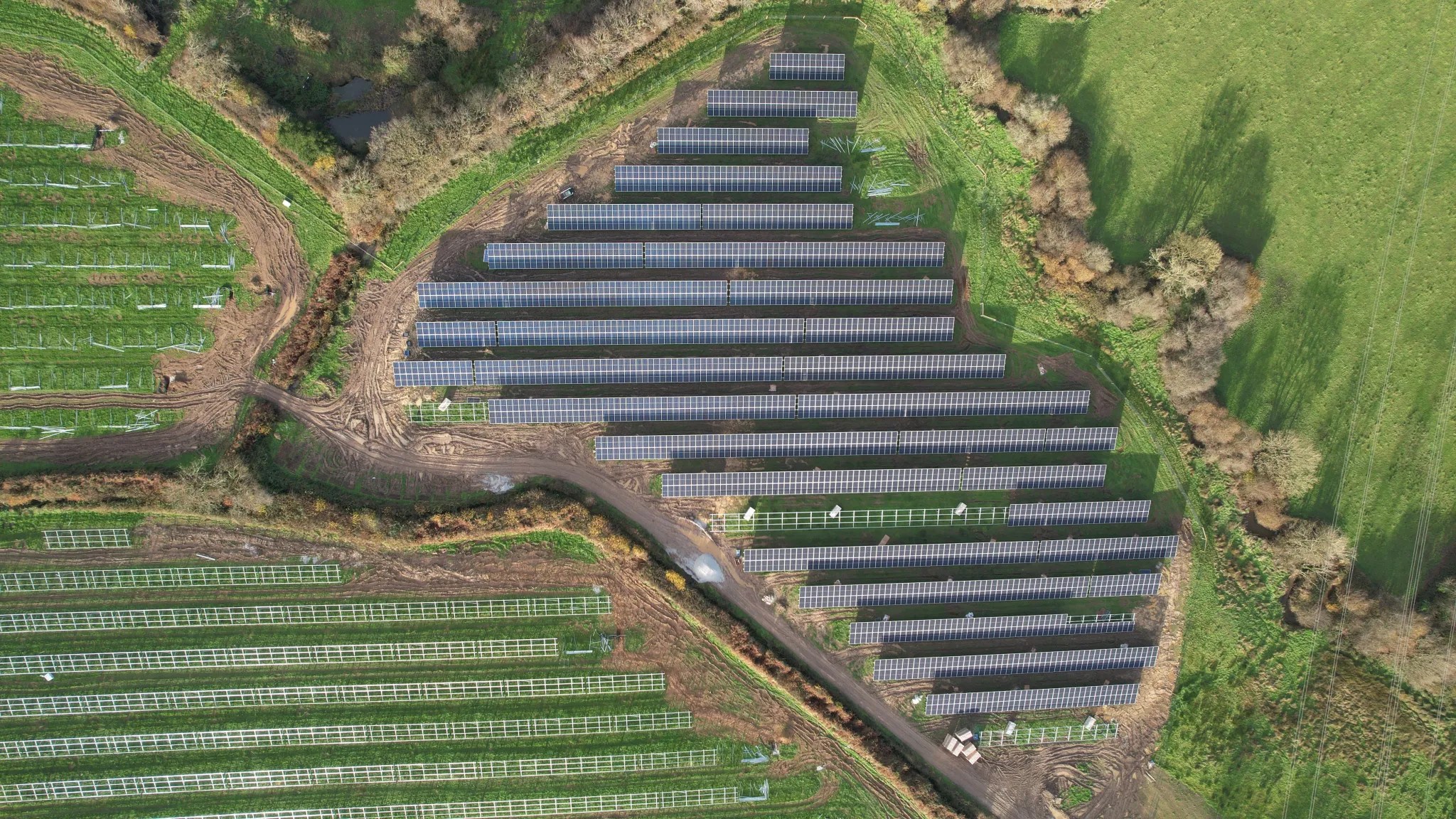
Solar panels are mounted on steel frames which are arranged in rows, with an approximate height of between 2.5m and 3m. There is often a ground clearance of 0.8m below the base of the solar panels, to allow for sheep grazing. In most cases, the steel frames are driven directly into the ground, to a depth of 1.5m using small piling rigs. This eliminates the need for concrete and significantly reduces ground disturbance.
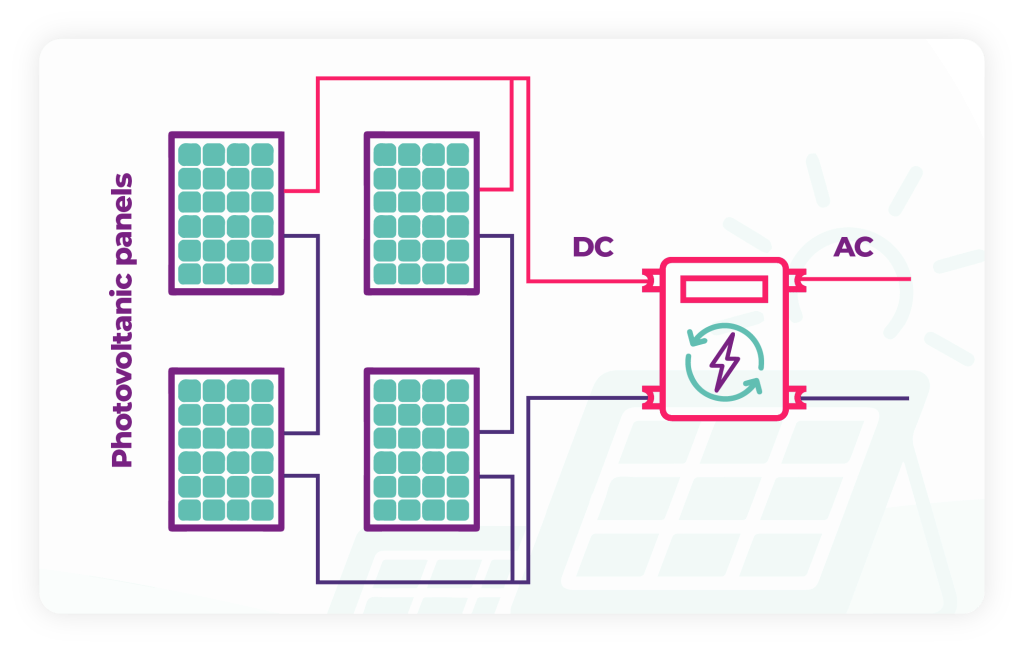
Energy inverters
Inverters are essential to a solar park as they transform the energy from a direct current (DC) to an alternating current (AC). We want electricity to enter the grid as an alternating current as it’s easier to step up or down (increase or lower the voltage) and it loses less energy along the way. The three main types of inverters are string, central and micro-inverters. For Derril Water Solar Park, we will be using the string variety. String inverters work by connecting each solar panel together in series. The inverter combines the direct current received from each individual solar panel and converts it, all at once, into an alternating current.
How do the different parts connect to generate electricity?
Solar cells are made from crystallised silicon sandwiched between conductive layers. Elements added to the silicon form a negative layer, which has an excess of electrons, and a positive layer, which has extra spaces for electrons called ‘holes’.
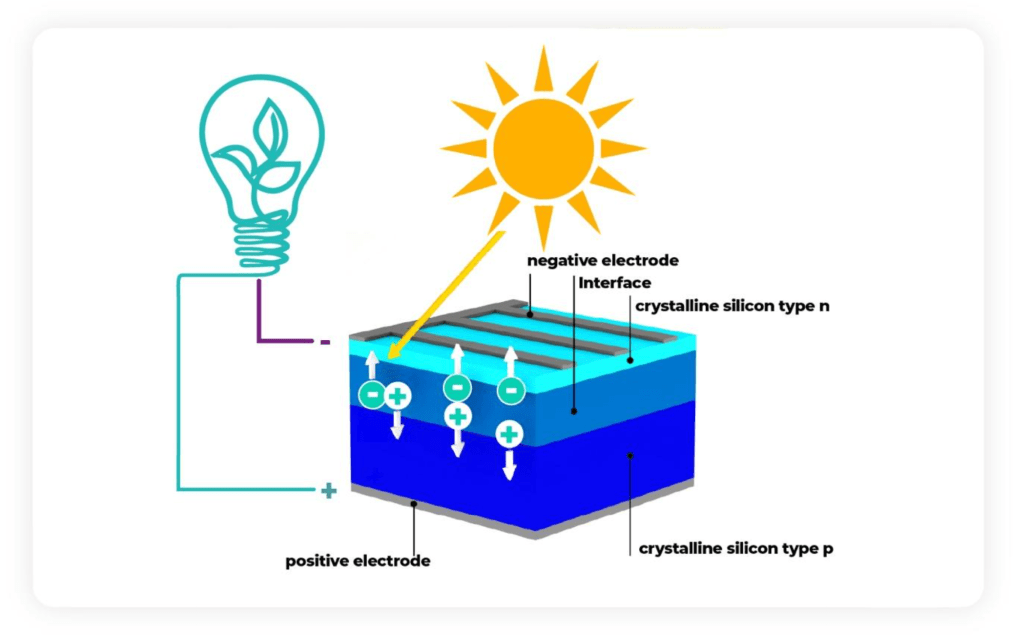
When a light particle, called a photon, strikes the silicon cell with enough energy, an electron is displaced and leaves a hole. The negatively charged electron and positively charged hole are now free to move around the cell. Because of the positive-negative layers, the electrons can only move one way: the electron is drawn to the positive side, and the hole is drawn to the negative side.
Green perks, like Ripple Energy membership, go beyond just saving money. They inspire a sense of purpose and pride in employees, allowing them to contribute to a more sustainable future. This, in turn, fosters a strong ESG (Environmental, Social, and Governance) culture within the company, something that’s been shown to be increasingly important to today’s workforce.
This is especially true of younger colleagues, who have been identified as undertaking an activity known as ‘climate quitting’ whereby they leave a role to find a greener, more ethical company to work for. Understanding that this trend is in motion, it is essential for companies to address the demand for climate awareness now, to secure long-term team members and therefore, stability of their businesses.
How does the electricity enter the grid?
Immediately next to each inverter is a transformer that increases the AC voltage to that of the local grid. Each transformer on the site feeds into electrical switchgear (see below) that links the solar farm to the Distribution Network Operator’s (DNO) substation. From here, it enters the national grid.
Switchegear
Switchgear is a term used to describe a collection of devices that manage the flow of electricity in a substation. Think of it as a sophisticated version of the circuit breakers and switches you have at home, but designed to handle much higher voltages and currents.
Here’s a simple breakdown of how switchgear works:
1. Isolation: Switchgear can disconnect parts of the electrical system for maintenance or in case of a fault.This is like turning off a specific circuit in your home so you can safely work on it.
2. Load Transfer: It can transfer electrical load from one source to another. Imagine you have two power sources and need to switch from one to the other without interrupting the power supply. Switchgear makes this possible.
3. Control: It controls the flow of electricity, ensuring that power is distributed efficiently and safely. This is similar to how traffic lights control the flow of cars at a junction.
4. Protection: Switchgear protects the electrical system from faults. If there’s a problem, like a short circuit, the switchgear can detect it and automatically disconnect the faulty part to prevent damage and ensure safety.
One of the key challenges with high-voltage electricity is that it can jump across gaps, creating dangerous arcs. Switchgear is specially designed to handle these high voltages and prevent arcing, ensuring that the electricity flows safely and reliably
Shared solar vs home solar
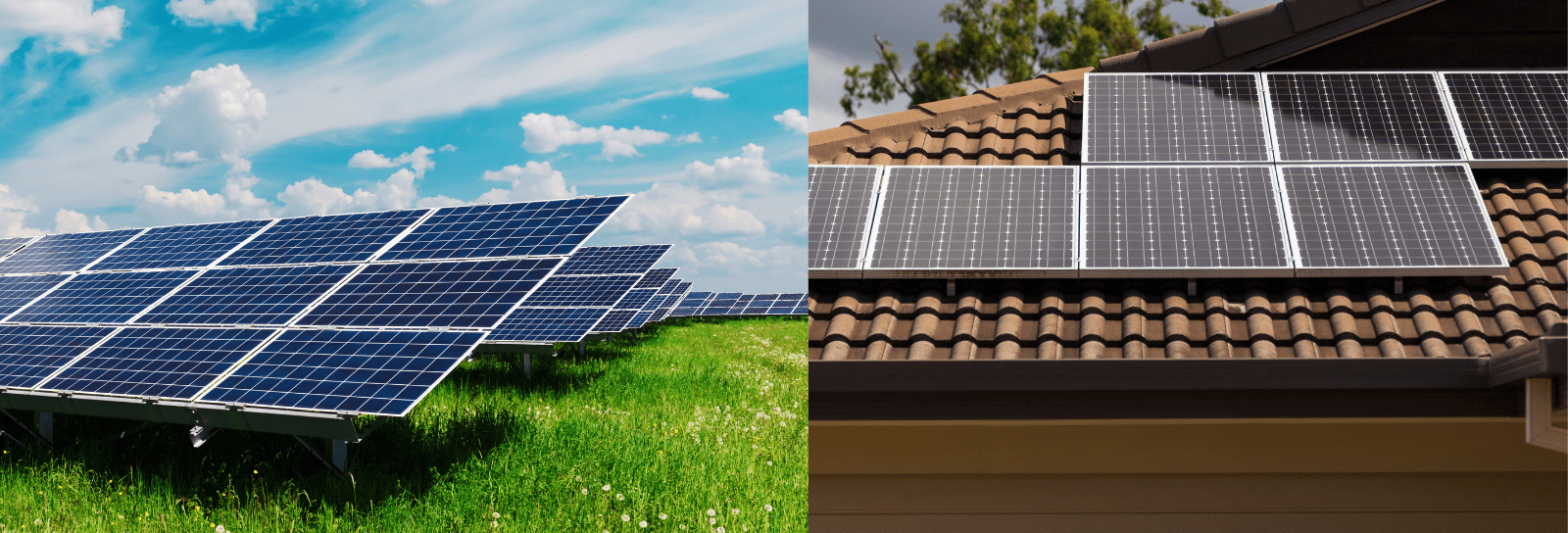
Home solar is a great option if you have the budget and the right living conditions (suitable roof, owned property etc.). However, we realise that this might not be a possibility for everyone, though green energy ownership should be.
Thanks to the economies of scale, Ripple projects are around 65% cheaper than the upfront cost of installing rooftop solar panels. And they are placed in optimum locations for maximum sunshine and efficiency so that just over five panels produce enough power for 100% of the average UK home’s consumption. Joining a Ripple, project means that you won’t need to worry about the maintenance of the solar park, as all upkeep and insurance is included in your (lower-than-home-solar) upfront cost.
If you already have rooftop solar, you can still own part of a shared solar park – your CO2 and energy savings will be the same whether you have home solar or not. They’ll just be in addition to your home solar savings too. As there’ll be more generation in the summer months, your savings will likely be extra high throughout this period. Owning a bit of a shared solar park is a perfect way to increase your generation from the sun, without having to add any more panels to your roof.
It’s also worth thinking about adding wind farm ownership to your green energy portfolio. Wind farms usually generate more electricity in the winter months, so your bill savings could be season-proofed across the whole year. Have a look at our wind farm projects, Graig Fatha, and Kirk Hill to see if future wind projects may be of interest to you.
Derril Water Solar Park
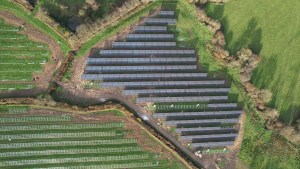
Derril Water Solar Park is the UK’s first shared solar park, where the ownership and the power are managed through a cooperative. It will span roughly 175 acres and will have over 70,000 solar panels! This will produce enough electricity to power 14,000 homes, while saving 19,000 tonnes of CO2 emissions each year.
String/central inverters will be used, with the DNO just around the corner to optimise the efficiency of electricity entering the grid.
To ensure the preservation of the land, the solar park structure will be constructed in accordance with the approved plans, with a height restriction of 2.8 metres. Less than 4% of the land will be physically occupied by the infrastructure, allowing sheep grazing to continue over 96% of the site.