At Ripple Energy, we help our members save on their electricity costs, giving them protection from electricity price rises for decades. People from all walks of life become wind farm and solar park owners, alongside thousands of others, as part of a renewable electricity cooperative.
But how do we do it and how do you save? To fully understand how being part of a Ripple-managed cooperative can protect your electricity bills, let’s first understand what makes up your electricity bill. Hopefully, this breakdown will give you a much clearer picture of how you pay for your electricity now, and how Ripple could help you to take control in the future.
What Makes Up Your Electricity Bill?
Your electricity bill typically consists of several different charges which, when added together, equate to your monthly electricity costs. It may surprise you that only around 29% of a typical bill is the actual electricity you use (although this can vary by tariff and supplier). The other 71% relates to taxes, grid charges, operating costs, and levies. Let’s identify them!
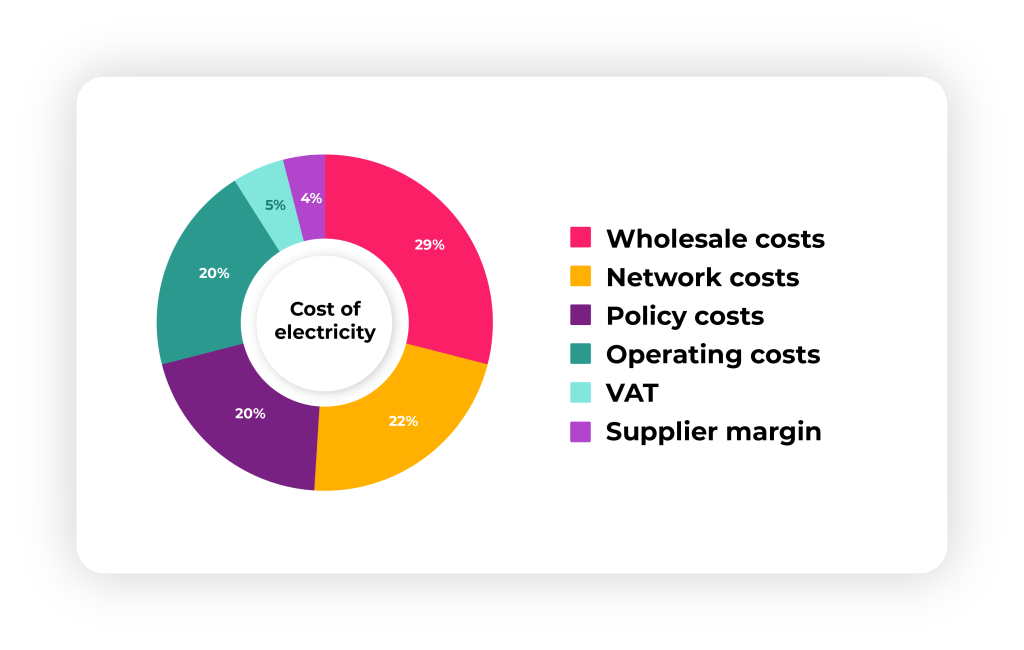
Wholesale costs: 29% of of typical bill
Lots of factors affect wholesale prices, including supply and demand, gas prices, geopolitical issues and increasingly, the weather. Wholesale prices tend to be higher in the winter when demand is higher and lower in the summer when demand is lower.
It is this part of your bill that Ripple helps with. Instead of your supplier buying power on the wholesale markets, it buys your power from your wind farm or solar park at its low and stable operating cost. The difference between the operating cost and what they would have paid on the wholesale market is passed on to you. This means when wholesale prices are high, your savings are higher and when wholesale prices are lower your savings would tend to be lower. We will explain in more detail further on.
Grid costs: 22% of a typical bill
Grid costs pay for the transmission and distribution networks that get power to your home.
Environmental/policy costs: 20% of a typical bill
Policy costs, also called ‘green levies,’ fund things like renewable energy support energy efficiency schemes and measures to tackle schemes, fuel poverty. Ripple is pushing for power from your own wind farm to be exempt from levies, so we will hopefully be able to remove most levy costs for our members in future.
Supplier operating costs: 20% of a typical bill
Operating costs are everything needed for your electricity supplier to provide you with a reliable service. This includes customer service, bill production, meter reading, and more. As more services move online or become automated (using a smart meter, which transmits your usage to your supplier automatically, for example) these costs remain typically a lower portion of your bill.

VAT: 5% of a typical bill
Value-Added Tax (VAT) is a government tax that’s added to your electricity bill every month. The current rate in the UK is 5% for domestic properties and businesses pay up to 20%. Taxes applied are based on consumption and, for business customers, type of operation. VAT is a mandatory cost.
Supplier margin: 4% of a typical bill
Supplier margin relates to energy suppliers’ earnings before interest and tax is applied, so is roughly the same as the supplier profit margin. This margin also has some built-in ‘headroom’ to cover unexpected supplier outgoings.
The wholesale electricity market price changes every half hour according to supply and demand. Suppliers tend to only buy a small amount of electricity in the half hourly market. Most power is bought under longer-term contracts. These contracts might fix the price for a day, month, or year or even as long as five or ten years. Ripple projects tend to fix prices for 12 months. Learn more about savings rates here.
What About Standing Charges?
Your bill is split into a standing charge and energy costs. Standing charges are a fixed amount per day, which you pay regardless of how much electricity you use. The energy element is paid for every unit you use. The standing charge tends to cover more fixed elements like grid costs, whereas the energy part covers more variable elements like electricity and levy costs.
How Ripple Reduces Your Bills
Electricity from large-scale wind and solar farms is the cheapest power source in the UK and Europe.
Electricity is generated from various sources, including wind, solar, nuclear, gas, and imports. Each source has a different production cost, ultimately affecting energy user bills.
At Ripple, we believe that everyone has the right to own their own source of clean and affordable electricity. We empower our members to reduce their electricity bills by offering ownership in renewable energy projects such as large wind and solar farms, which produce the UK’s cheapest electricity. This approach allows members to lower the consumption portion of their electricity bills.
Here’s how we do it:
- Community-driven electricity for all: Ripple enables everyone to own their own source of clean, affordable power, via cooperatives. . When it comes to electricity, scale is really important for accessing cheaper costs, more easily. We bring together thousands of people to collectively build and own new renewable electricity projects, such as wind farms and solar parks. This not only helps green the UK grid faster, but also secures each owner electricity bill savings every month for decades to come.
- Lower bills: Reduced electricity costs are shown as credits on Ripple members’ electricity bills. This is because our partner suppliers buy electricity from a member’s wind farm or solar park, instead of buying it from the wholesale market. This reduces their bills.
See how much you could save. The savings depend on the electricity market price and the amount of electricity generated by the wind farm.