Welcome to our monthly project updates. On this blog, you’ll find all Derril Water Shared Solar Park news.
January
Work on Derril is continuing at pace. As a result of last month’s share offer, the UK’s largest shared solar park is now even bigger! We welcomed over 600 new members. Hundreds of existing Derril members also chose to increase their original ownership in the project. This puts the total members in Derril Water at over 9,600, with in excess of £22M raised. That’s more than 10 times larger than Graig Fatha, our first project.
We are now working at breakneck speed on the EPC contract with the preferred contractor and their lawyers, the bank and their technical advisors and lawyers, and RES providing construction management services. We will share contracted programme milestone dates with you as soon as possible.
Ecology studies have been completed, with reports being prepared to discharge planning conditions. Other studies have also been conducted, specifically to support transformer energisation.
Design work also continues, marking a proactive start to 2023. We’ll be down on site with Rodrigo next month, bringing you his latest video update.
November & December
As we look to wrap up the year, Simon, our Chief Projects Officer, has given a short summary of progress over the last few months and what is currently happening on site. You can read this below, or if you prefer to watch, Rodrigo, our Project Manager, filmed a quick update when he was down on site. You can watch this here.
Following on from the completion of the share offer, the next step is clearly to start construction. Prior to works starting on site there’s a lot to be done, and of all of it needs to be reviewed and subject to robust contracts.
The works are typically done under an ‘EPC’ contract – that’s engineer, procure and construct. The first step to secure that contract was to go out to the market to identify contractors that were sufficiently experienced and had availability to take on the work – that narrowed the field down significantly as there is a great deal of activity in the market at the moment, and not just in the UK.
Once we had our shortlist we were able to issue an ‘RFP’ (request for proposal) pack. This contained all the information the contractors might need to inform their proposal – things like topographical and geotechnical survey results, grid connection details, planning details and environmental information. In addition it set out the scope and specification of the works we want done. In all of this we have been greatly supported by RES who have been able to leverage their position as a global developer.
The shortlisted contractors have then complemented the information provided to them with their own site visits and engagement with local contractors to enable them to make competitive and realistic proposals.
As one might expect, a contract for tens of millions of pounds will be negotiated carefully, and this takes time, in particular as contractors don’t want to over-promise and under-deliver, or be exposed to unknown risks.
To enable the ordering of long lead items such as switchgear and transformers, electrical studies are being completed under an ‘early works agreement’ so the equipment can be specified. These studies will also feed in to the EPC contract itself so that costs are defined accurately.
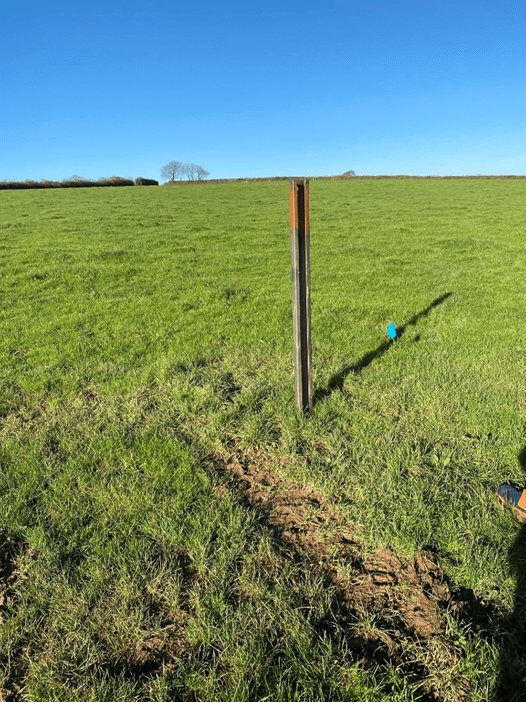
Another key study that is being undertaken is the ‘pull out tests’ – these basically involve whacking posts into the ground and then several days later pulling them out again. The force required to pull them out dictates the specification of the piles used to anchor the mounting racks for the panels, ensuring they won’t lift up.
In addition, the design of the passing places on the public road that were a condition of the planning permission has been done to ensure those works can be done in advance of the main solar park construction works and not hold anything up. Various ground surveys have been done to inform those designs, including ‘dynamic cone penetration tests’ which measure the ‘CBR’ (California bearing ratio) of the ground – in essence that’s how strong the ground is and how much weight it can bear.
As we progress towards getting the EPC contract into place, thereby confirming the construction programme, we have been very pleased to see that solar panel prices have come down quite significantly in the last few months. This is something we will be able to benefit from in the final price, delivering greater value for you.
October
In line with our updated timeline, an Early Works Agreement has been signed with the candidate EPC contractor to allow them to proceed with surveys and detailed design. These surveys include things like:
- pull out tests which determine the exact type of piles that will be needed for the mounting racks;
- harmonics studies which determine if specific equipment is needed for the grid connection;
- inrush studies which determine what protection might be required to accommodate the flow of power when transformers switch on;
- earthing studies which determine the amount of copper needed; and
- other protection studies.
All of this enables the contractor to place orders for long lead items such as transformers, switchgear and the solar panels themselves.
The candidate EPC contractor is now attending our monthly meetings with the grid company (the DNO, Distribution Network Operator, which is National Grid Energy Distribution in this part of the country) as they will be leading the grid studies, which will play a crucial role in defining the project’s design.
The design for our suggested passing places has been approved by Devon County Council (DCC) and the road safety audit has been completed.
The surface drainage design has been completed and submitted to DCC for condition discharge.
September
September saw plenty of progress in the Derril Water planning discharge conditions. We were in the final stages of securing the EPC contractors. This will determine the key milestones and the timeline of the build schedule. Once this initial stage has been completed, we’ll issue an updated timeline. Rodrigo, your Ripple Project Manager is overseeing the project from start to finish. Watch his September update here.
August
Over the past month, the Derril Water team have been busy behind the scenes progressing the pre-construction works.
Neo Environmental have been working on the Written Scheme of Investigation (WSI) with the County Archaeologist. This confirms what archaeological works will need to be carried out prior to and during construction to meet the planning conditions.
Southwest Geotechnical (SWG) are doing ground investigation works by the public road where passing places will be constructed. After this, RES will design those passing places for approval by the roads authority.
We are now in the latter stages of negotiating prices with candidate Engineering, Procurement and Construction (EPC) contractors. Once we have selected the contractor we’ll be working with we’ll be able to give more detail on final designs and components as the project moves into its next phase.
June and July
There was plenty going on behind the scenes to get Derril Water ready in June and July. Neo Environmental via RES were providing some technical support to enable discharge of planning conditions, including:
- determining the methodology and excavation requirements for the archaeological Written Scheme of Investigation (WSI); and
- developing a surface water management scheme that will be put into effect by the Engineering, Procurement and Construction (EPC) contractor to mitigate surface water risks.
A highway survey between the site and Thorndorn Cross will be done in October, closer to the time of construction, to determine the condition of the road to inform what repairs may be required.
Geotechnical investigation will be done at each of the seven passing places on the public road in the coming weeks to determine the ground conditions and assist with pavement design.
May
As our latest Ripple project, we were excited to get the wheels turning in the development of Derril Water Shared Solar Park.
After closing the public share offer on the 22nd May, we welcomed over 8,700 members including over 7,000 brand new members into our third project, our first solar park. They now own not only our biggest project to date, but also the largest single raise in British co-operative history!
Whilst the actual development of the project will not commence until after discharge of planning conditions, site investigation works have begun at Derril Water Shared Solar Park. These form part of the geotechnical investigation which is crucial in helping potential EPC (engineering, procurement and construction) contractors who will build the project determine the design and construction. We’re pleased to share a photo of the recent works on site.

This picture shows a set up with two rigs for penetration tests, boreholes and pile pull-out tests. Rigs are used to drill holes in the ground to gather soil samples and rock cores for testing.
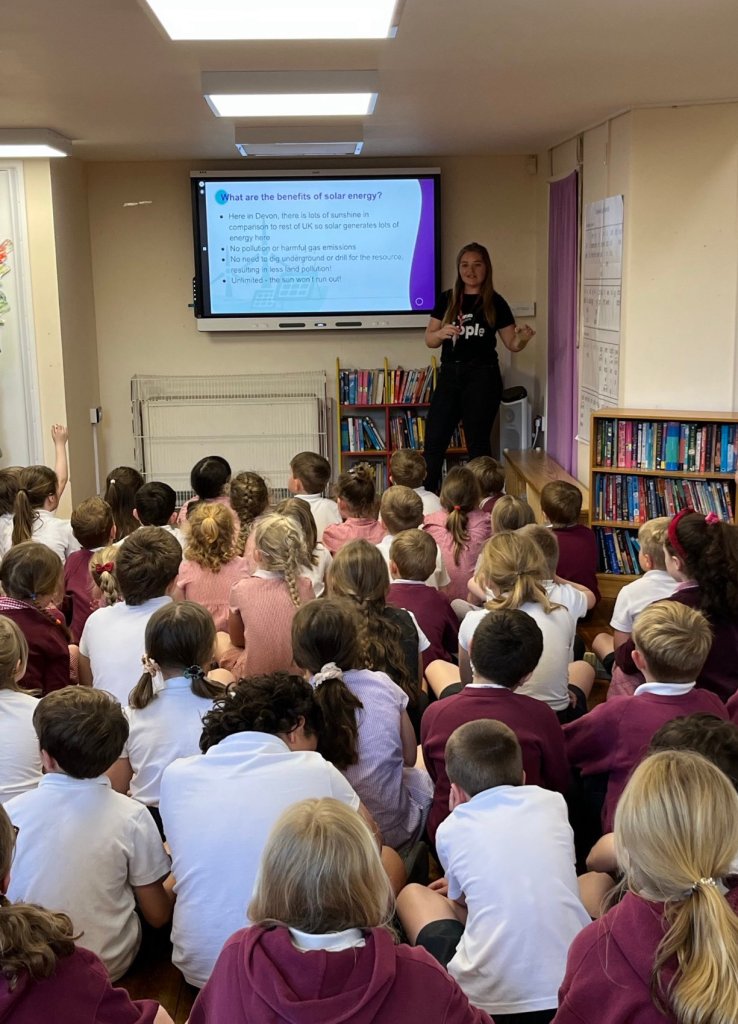
Also in May, we visited our youngest Derril Water Shared Solar Park members at Bridgerule CoE Primary School, who are proud owners of a small part of the solar park, only 2 miles away, to help power their school. The students were so excited to share with us their ‘green hopes for the future’, and were amazed to hear that the solar park will be generating electricity until they’re 50 years old!